
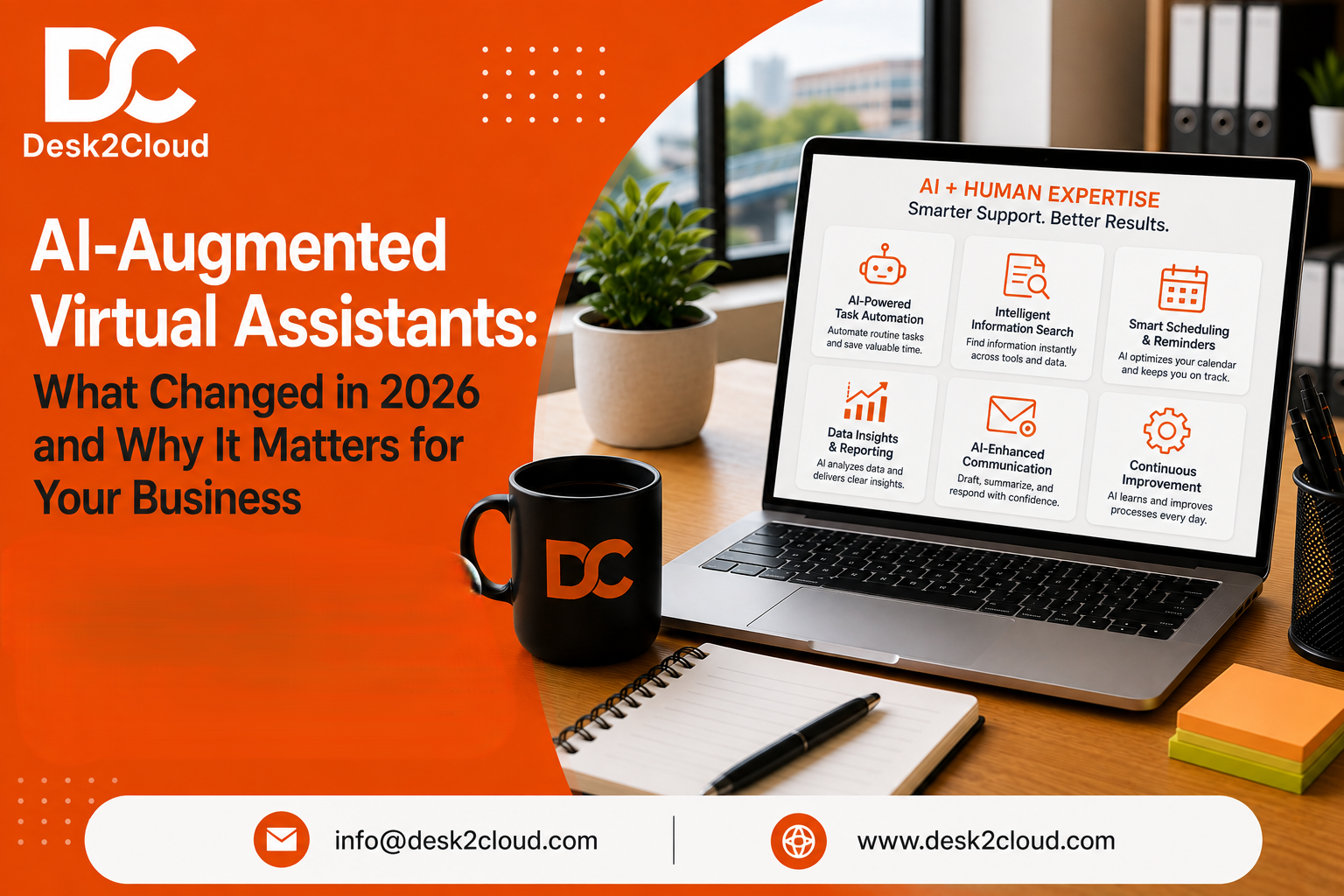
AI-augmented virtual assistants are human virtual assistants who use AI tools like ChatGPT and Claude to complete work faster, without losing the judgment, accountability, and relationship management that AI alone cannot provide. In 2026, this hybrid model has become the standard for businesses that want speed and reliability at the same time, rather than choosing one over the other.
If you are wondering whether to hire a human virtual assistant, adopt an AI tool, or do both, this blog explains what actually changed in 2026, why the hybrid model wins, and how to apply it to your own business.
What Is an AI-Augmented Virtual Assistant?
An AI-augmented virtual assistant is a trained professional who blends manual expertise with AI-powered tools to handle a heavier workload in less time. Instead of manually drafting every email, researching every topic, or formatting every report, the assistant uses AI to handle the repetitive first pass, then applies human judgment to review, correct, and finalize the work.In 2026, AI-augmented virtual assistants evolved beyond basic, scripted FAQ chatbots into intelligent digital agents that can independently handle multi-step tasks, access real-time business data, and coordinate workflows across multiple systems.
This is different from a fully automated chatbot or AI agent. A chatbot executes tasks without context. An AI-augmented VA understands your business goals, catches AI errors before they reach a client, and takes ownership of outcomes, something automation alone cannot do.
What Changed in 2026?
A few shifts pushed AI-augmented support from a nice-to-have into a business standard this year.
-
AI tools became reliable enough to trust for first drafts. Tools like ChatGPT and Claude now handle research, summarization, and scheduling with far fewer errors than earlier versions, making them practical for daily business use.
-
The productivity gap became measurable. Industry data shows AI-augmented human VAs can now deliver close to three times the output of a traditional VA at the same cost, according to 2026 virtual assistant industry research (Wishup VA Industry Trends 2026).
-
Businesses learned the limits of AI-only support. Standalone AI tools remain excellent at execution speed but weak at strategy, negotiation, and reading nuance, which is why the human layer stayed essential even as AI adoption grew.
-
Hiring standards shifted. Virtual assistant providers began screening for AI proficiency as a core skill, not an optional extra, when placing new team members.
AI-Only vs Human-Only vs AI-Augmented: A Quick Comparison
|
Factor |
AI Tool Alone |
Human VA Alone |
AI-Augmented VA |
|
Speed on repetitive tasks |
Very fast |
Moderate |
Very fast |
|
Judgment and context |
Limited |
Strong |
Strong |
|
Error correction |
Requires human review |
Reliable but slower |
Fast and reliable |
|
Client relationship management |
Not possible |
Strong |
Strong |
|
Cost efficiency |
Low cost, limited scope |
Higher cost per task |
Best value for output delivered |
|
Accountability |
None |
Full |
Full |
This comparison is why most growing businesses in 2026 are not choosing between AI and humans. They are combining both through a managed virtual assistant service built around this hybrid model.
Why This Matters for Your Business
Choosing the right support model directly affects cost, output quality, and how much time you spend managing the work yourself.
You get more output without more headcount. An AI-augmented assistant can research, draft, and organize work in a fraction of the time a purely manual process would take, which means one person can now handle what previously required two or three.
You reduce the risk of AI errors reaching clients. AI tools can produce confident but incorrect information, often called hallucinations. A trained human assistant reviewing that output before it goes out the door protects your business from costly mistakes.
You stay competitive without a large budget. Small and mid-sized businesses can now access the kind of output volume that used to require a bigger internal team, which levels the playing field against larger competitors.
For businesses handling documentation and reporting specifically, this hybrid approach pairs well with our data and reporting services, where AI speeds up data organization and a human ensures accuracy before delivery.
How the Hybrid Model Works in Practice
A simple way to understand the workflow is to break it into three stages.
-
AI handles the first pass. Research, data organization, drafting, and scheduling are completed quickly using AI tools.
-
The human VA reviews and refines. The assistant checks for accuracy, aligns the output with your brand voice, and corrects any AI errors.
-
The human VA delivers and manages the relationship. Final communication, follow-ups, and client-facing work stay human, preserving trust and accountability.
This structure is already reshaping industry-specific work. In real estate, AI-augmented coordinators handle transaction documents and deadlines while humans manage client relationships. In healthcare, AI manages scheduling and reminders while human staff handle patient coordination, a pattern documented in recent virtual assistant industry forecasts (VA Masters Future of Virtual Assistants Report).
Common Concerns About AI-Augmented Support
Business owners considering this model often raise a few valid questions.
-
"Will AI make mistakes I don't catch?" This is why the human layer matters. A trained assistant reviews AI output before anything is finalized, catching errors automation would miss.
-
"Is my data safe with AI tools?" Work with a provider that uses secure, controlled environments rather than unmonitored public AI plugins, and confirm your data is never used to train outside models.
-
"Will this replace the personal service I expect?" No. The model is built specifically to preserve human judgment and communication while removing repetitive manual work, not to remove the human entirely.
How to Get Started With AI-Augmented Support
-
Identify repetitive tasks first. Research, data entry, scheduling, and first-draft writing are strong starting points for AI augmentation.
-
Choose a provider that trains for both skills. Look for a team with both administrative expertise and AI tool proficiency, not just one or the other.
-
Set a review process. Confirm that a human checks AI-assisted work before it reaches clients or goes into official records.
-
Track the output difference. Compare turnaround time and task volume before and after adopting the hybrid model to measure real impact.
If you are exploring this for administrative or documentation-heavy work, our admin and documentation support services already apply this hybrid approach for clients across the USA.
An AI-augmented virtual assistant is a human professional who uses AI tools to complete repetitive work faster, then applies judgment and quality control before delivery. In 2026, this hybrid model became the business standard because it combines the speed of AI with the accountability and relationship management only a human can provide.
FAQs About AI-Augmented Virtual Assistant
1. What is an AI-augmented virtual assistant?
An AI-augmented virtual assistant is a human professional who uses AI tools to complete repetitive tasks faster while applying human judgment, review, and accountability before the work is delivered.
2. Will AI replace human virtual assistants?
No. AI is augmenting virtual assistants, not replacing them. Businesses continue to rely on human judgment for strategy, client relationships, and error correction that AI alone cannot provide.
3. Is an AI-augmented VA more expensive than a regular VA?
Not typically. Because the assistant completes more work in less time, businesses often get significantly more output for the same or similar cost as a traditional virtual assistant.
4. How does a human VA catch AI mistakes?
A trained assistant reviews AI-generated drafts, research, and reports before they are finalized, correcting inaccuracies or hallucinations and ensuring the output matches business standards.
5. Which business tasks benefit most from AI augmentation?
Research, data organization, scheduling, first-draft writing, and reporting see the biggest efficiency gains, while client communication and relationship management stay human-led.
Conclusion
The debate in 2026 is no longer AI versus human virtual assistants. The businesses seeing the strongest results are the ones using both together, letting AI handle speed and volume while a trained human ensures accuracy, judgment, and trust. If your business is still relying on manual processes or unmonitored AI tools alone, the hybrid model is worth exploring.
Want an assistant who combines AI speed with real human accountability? Contact Desk2Cloud today to build an AI-augmented support team for your business.